
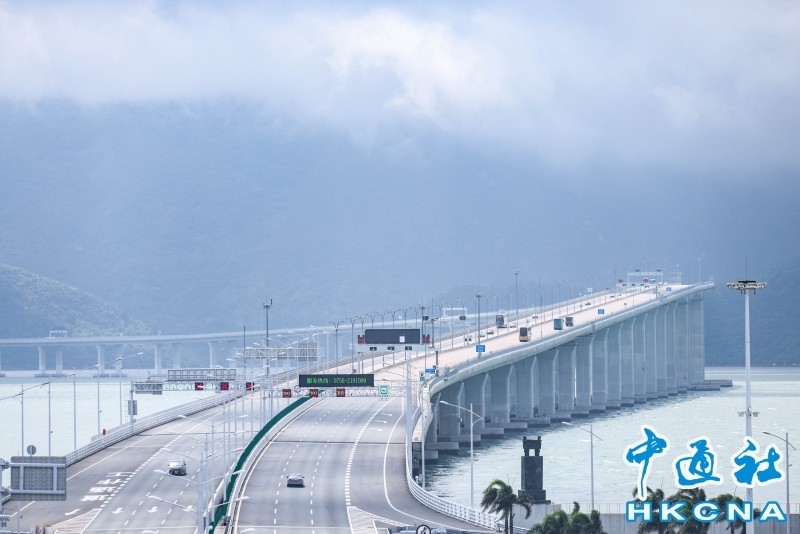
Southeast Asia Information Port News (www.dnyxxg.com) – According to the "Guangdong Vehicles Southbound" policy, starting December 23 (Tuesday), Guangdong vehicles will be allowed to enter Hong Kong's urban areas, with a daily quota of 100. Approved Guangdong vehicles that have completed their reservations can enter via the Hong Kong-Zhuhai-Macau Bridge from midnight on the 23rd, with a maximum stay of 3 days per entry.
It is understood that the December quota for Guangdong vehicles entering the urban area has been drawn up. The Hong Kong Transport Department began accepting applications from qualified Guangdong private car owners on December 9th. Data released on the 18th showed that over 700 applications had been received from 1700 successful applicants. After approval by the department, applicants will complete vehicle inspection, verify electronic contact information, purchase insurance, and submit documents. They will then receive an electronic permit, approval letter, and a Hong Kong license plate with the prefix "FT". After completing the Hong Kong licensing procedures, the mainland authorities will file the application and send an approval notice. The Transport Department recommends that vehicle owners install Hong Kong license plates before traveling and top up their "EasyPass" accounts to pay tunnel tolls.
It is important to note that Hong Kong's road design and driving rules differ significantly from those of the mainland, and left-hand drive vehicle owners should be well-prepared. Regarding traffic regulations, the general speed limit in Hong Kong is 50 km/h. On expressways, drivers must keep to the far left lane and overtaking is only permitted on the right. Roundabouts must be traveled clockwise. Double white lines on roads are equivalent to double yellow lines on the mainland, and crossing them is prohibited. Unless otherwise indicated by a special light signal, vehicles cannot proceed straight or turn at a red light. In the event of a traffic accident, vehicle owners must immediately call 999 to report the accident and notify their insurance company. They should wait at the scene for police investigation, and if necessary, call a tow truck. A claim form must be submitted within 24 hours.
The Hong Kong Commercial Daily points out that this move marks a higher level of connectivity between the two places and is an important step in building a "one-hour living circle" in the Greater Bay Area. The policy will greatly facilitate the lives and business exchanges of residents in the Greater Bay Area, enrich travel options to Hong Kong, and cater to the needs of family leisure travel and in-depth travel, making "dual-city living" and "multi-city living" more feasible. It showcases Hong Kong's achievements in integrating into the overall national development strategy, deepening the interconnectivity of the Greater Bay Area, and the institutional vitality of "One Country, Two Systems." As quotas are gradually relaxed and applicable cities expand in the future, the policy's synergistic "multiplier effect" will become more apparent, achieving deep integration of economic and social life, pooling the Greater Bay Area's consumption and innovation power, and enhancing Hong Kong's competitive advantage.
To facilitate travel, Baidu Maps' lane-level navigation has been fully launched in Hong Kong and Macau. This navigation system relies on AI technology to accurately depict 3D road models, providing lane-level precise guidance for Hong Kong's dense roundabouts and Macau's complex intersections. It also exclusively offers Cantonese voice packs such as "Lin Xue" and "Li Caijiao."
Macau Chief Executive Cen Haohui stated that the "Macau vehicles traveling north" policy has been widely praised since its implementation in 2023. The Hong Kong-Zhuhai-Macau Bridge sees approximately 12,000 vehicles entering and exiting daily, and demand continues to grow. Regarding whether to increase the number of entry and exit channels, he stated that the policy requires coordination among Guangdong, Hong Kong, and Macao to avoid congesting Macao's traffic flow, and that he would actively communicate with both Guangdong and Hong Kong to refine the plan. Regarding the "Guangdong vehicles traveling south" policy, Cen Haohui said he would closely monitor its implementation in Hong Kong and conduct research based on Macao's actual traffic situation. (End)


