
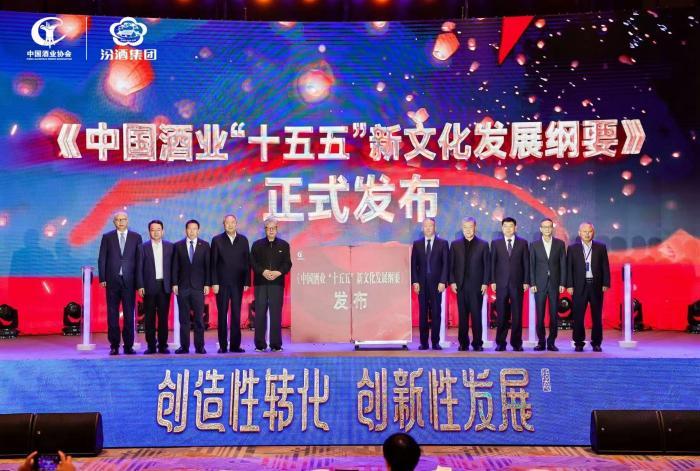
Southeast Asia Information Port News (www.dnyxxg.com) – On November 12th, the 4th China Alcoholic Drinks Industry Living Culture & Internationalization Conference and the release ceremony of the "15th Five-Year Plan for New Cultural Development of China's Alcoholic Drinks Industry," themed "Creative Transformation and Innovative Development," opened in Taiyuan. The conference was hosted by the China Alcoholic Drinks Association and organized by Shanxi Xinghuacun Fenjiu Group Co., Ltd. and the Cultural Work Committee of the China Alcoholic Drinks Association. The conference focused on in-depth discussions on topics such as the living heritage, innovative transformation, and international development of China's alcoholic drinks industry, centering on the core link of living culture.
Song Shuyu, Chairman of the China Alcoholic Drinks Association; Yuan Qingmao, Secretary of the Party Committee and Chairman of Fenjiu Group; Li Zhenhuan, Full-time Deputy Secretary of the Party Committee and Vice Chairman of Fenjiu Group; and Ren Zhihong, Secretary-General of the Cultural Work Committee and Cultural Heritage Protection Committee of the China Alcoholic Drinks Association, attended the conference as representatives of the host and organizer. He Yong, Secretary-General of the China Alcoholic Drinks Association, presided over the conference.
More than 100 liquor companies and merchants, including Kweichow Moutai, Yibin Wuliangye, Luzhou Laojiao, Jiangsu Yanghe, Anhui Gujing, Sichuan Langjiu, Guizhou Xijiu, Sichuan Jiannanchun, Beijing Shunxin Niulanshan Winery, Beijing Hongxing Shares, and Jinhui Liquor, joined hands with industry associations and liquor culture research institutions such as the Shanxi Provincial Brewing Industry Association, Shanxi Provincial Time-Honored Brand Association, Shanxi Provincial Food Industry Association, Shanxi Provincial Liquor Industry Chamber of Commerce, and Hebei Provincial Liquor Collection Culture Association to participate in the conference, forging a powerful synergy for industry collaborative development.
As the pioneer and practitioner of the "living culture" concept in the liquor industry, Yuan Qingmao, Secretary of the Party Committee and Chairman of Fenjiu Group, systematically elaborated on Fenjiu's core strategies and exploration achievements in the internationalization arena in his keynote speech, "The Internationalization 1.0 Model of the Fenjiu Revitalization Program System." Currently, Fenjiu has built a "three-pronged approach" of marketing to overseas Chinese, interactive marketing with overseas Chinese businesses, and localized marketing, completing a strategic layout covering 72 countries and regions and more than 200 cities across five continents. Building upon this foundation, Fenjiu is focusing its efforts on nine key areas: international brand operation, international cultural dissemination, international standard promotion, international taste expression, international product expression, international pricing, international pilot programs in core cities, international warehousing and logistics, and international production bases. This includes deeply penetrating mainstream consumption scenarios through its presence in over a thousand overseas bars, creating a distinctive international cultural IP through the "Fenjiu Accompanies You Through Summer" series of events, and launching products tailored to the global market, such as the "Belt and Road" high and low alcohol series and "Qingxiang 25," continuously strengthening its international market competitiveness.
Song Shuyu, Chairman of the China Alcoholic Drinks Association, delivered a keynote speech entitled "What is National is International," precisely pointing out at the outset that the vibrant nature of Chinese liquor is the essential characteristic of the new culture in the industry. He noted that the vibrant charm of Chinese liquor is rooted in the millennia-old yet ever-evolving brewing techniques, flows through the folk customs and etiquette of social settings, and is manifested in the continuously evolving aesthetics of life. It embodies fourfold confidence: culture, civilization, brewing, and lifestyle, making internationalization a conscious action for the entire industry. Addressing the pain points and difficulties of the wine industry going global, he identified five key directions for "breaking down cognitive barriers": breaking the mindset that "Chinese baijiu is difficult to export," achieving a cultural leap from "Chinese fine wine" to "world-renowned wine," adapting to diverse consumption scenarios that blend Chinese and Western elements, reshaping the value label of "scarcity and preciousness," and upgrading the development pattern of the "global industry." He also provided four practical paths: promoting industry collaboration to form a synergistic force for overseas expansion, achieving an upgrade from product export to capacity output, advancing the application for "World Heritage status" for Chinese wines, and focusing on aroma characteristics to conduct precise international communication, thus pointing the way for the industry's international development.
Fu Lingxiao, Vice President of Public Affairs and Communications for Diageo Greater China, delivered a speech on "Practice and Reflection on the Internationalization of Spirits," sharing international experience in the globalization of spirits. He suggested that the internationalization of baijiu needs to adhere to the core of living brewing while adapting to global consumption habits through product innovation (optimizing taste and reducing alcohol content), allowing the living culture to both "preserve tradition" and "innovate." Simultaneously, he emphasized strengthening industry collaboration to enhance international discourse power through a unified expression of living value. The conference officially released the "Outline for the Development of New Culture in China's Wine Industry during the 15th Five-Year Plan Period." The outline focuses on the core task of "systematically promoting the construction of living culture," taking the development path of "moving from the era of corporate culture to the era of industrial culture." It scientifically constructs the "139 Plan," listing "the identification, protection, and utilization of living cultural heritage" as one of the three key tasks. It clearly states the need to prioritize the protection of living relics not yet included in the existing system, such as brewing microbial communities and poetry and songs, and promotes the establishment of an interdisciplinary field of Chinese wine studies to provide academic support for living heritage transmission.
Concurrently, the conference launched the drafting of the "Group Standard for Oral History of China's Wine Industry" and established the "China Wine Industry Oral History Research Center." As an important platform for the transmission of living culture, the center will systematically record the techniques, memories, and experiences passed down orally in the brewing industry through oral history methods, achieving standardized recording and transmission of living memories, effectively preserving oral techniques and industry stories on the verge of extinction, and providing strong support for the development of living culture in the wine industry.
It is reported that this conference, with "living culture" as its core anchor, deeply integrates the inherited genes of millennia-old wine industry civilization with the contemporary issues of cultural innovation and international development. Through the dual efforts of empowering corporate practices and leading industry strategies, it clearly outlines the practical blueprint and global layout for the construction of a living culture in China's wine industry. (End)


