
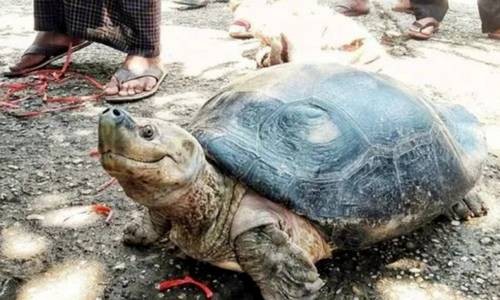
Southeast Asia Information Port (www.dnyxxg.com) reports that the rare "Thai" turtle, currently found only in Myanmar, is being kept in captivity in its native habitat and park on the natural sandbar near the Lin-pha Pagoda on the Chindwin River in Khamti Township, Sagaing Region. The population has now grown to over 1,000 individuals.
After approximately 20 years of conservation and breeding efforts in Myanmar, the Tai turtle population has now reached over 1,000 nationwide. To ensure its adaptation to the natural ecosystem, it is being kept in captivity along the Chindwin River. Every year after a year in captivity, 200 turtles are released back into the wild. In the third week of June, 25 male and 25 female Tai turtles were released into the Chindwin River, marking the sixth release this year in conjunction with the public.
The female Burmese Tai turtle has a brown or grayish-brown carapace, while the male has three distinct black stripes. Adults reach a carapace length of 58 cm. In the past, the Burmese Tai turtle was commonly found in the Irrawaddy, Chindwin, and Sit-taung Rivers and their tributaries, but it nearly became extinct due to overhunting. In 2004-05, foreign biologists discovered Tai turtle eggs near a floating pagoda on Lin-pha Island in Khamtai Township, Sagaing Region. Subsequent research was conducted jointly by the Department of Environmental Conservation and the Upper Chindwin River Tai turtle conservation organization (NGO), leading to the turtle's continued care and reproduction, eventually reaching a population of over 1,000.
It is understood that there are approximately 300 species of turtles worldwide, with 32 species found in Myanmar. Based on their habitat, they are divided into two main categories: terrestrial turtles and aquatic turtles. Aquatic turtles are divided into freshwater turtles and saltwater turtles, and according to their diet, they are further divided into herbivorous turtles (which only eat leaves, grasses, vegetables, etc.) and omnivorous turtles. Most turtles living in water are omnivorous. The Dai turtle is now listed on the International Union for Conservation of Nature (IUCN) Red List of Threatened Species, and in Myanmar, it is a fully protected species.
“The Dai turtle now exists only in Myanmar, making it a unique and rare species found nowhere else in the world. We are proud to have been able to maintain and propagate it. There are now over 1,000 Dai turtles in Myanmar. No other country in the world has this species, so we must continue to maintain and ensure its survival. We will continue to work with the Department of Environmental Conservation on conservation efforts,” said U Myo Win, head of the Taiping Tun turtle conservation organization.
This species of Dai turtle has not been found in Southeast Asian countries. Several Dai turtles from Myanmar are kept in zoos in Singapore. The zoo now exhibits them to the public. It is said that a similar species of Tai turtle exists in Cambodia, but details are unknown. Currently, the conservation work for the Tai turtles in Myanmar is mainly carried out on the sandbar of the Lin-pha Island pagoda in the middle of the Chindwin River in the Kandy region. This is the original habitat of the Tai turtles, so it was specially chosen as the location for conservation work. Several zoos in Myanmar, including Mandalay Yadanapon Zoo, Bagan's Lawga-nanda Park, and Yangon Zoo, all house and exhibit these Tai turtles. Tai turtles generally have a lifespan of 60 to 100 years, and their age can be estimated by the stripes on their carapace, according to some people familiar with the Tai turtle's characteristics.


