
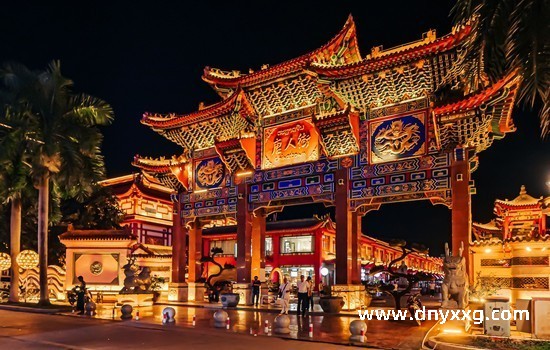
Eighteen years after its establishment, the Golden Triangle Special Economic Zone in Bokeo Province, Laos, has transformed from a remote rural area into an investment and tourism hub, but its security governance remains under scrutiny.
Established in 2007 under a 1999 concession agreement, the zone reflects Laos' ambition to revitalize its border regions and deepen regional market connectivity. With massive investment, new infrastructure, and a growing population, the Golden Triangle Special Economic Zone has become one of the country's most representative development experiments, drawing both praise and criticism.
From Rural Wasteland to Economic Hub
When the Lao government initially signed the concession agreement for the special economic zone in Dongpeng District, the area was nothing more than a wilderness of farmland and forest, surrounded by mountains and crisscrossed by rivers. At that time, poverty was widespread, infrastructure was lacking, and development opportunities were scarce.
The concession zone initially covered 827 hectares, but over the years it has expanded to 10,000 hectares. This vast land has been planned as a hub for modern infrastructure, tourism, agriculture, and services, aiming to help the region escape poverty and create employment opportunities.
Developers led by the Kings Romans Group have laid the foundations for a small city. Roads, checkpoints, schools, hospitals, drainage systems, green spaces, and even an international airport have been built. A public surveillance system is also in operation to enhance security and order within the area.
Kings Romans Group Chairman Zhao Wei summarized this vision with a well-known proverb: "The Lao people lent me a piece of land, and I will return a city to them."
"Alternative Economy": Breaking the Old Cycle
The core concept of the Golden Triangle Special Economic Zone and its developers is to promote an "alternative economy" to replace the drug-related economy that once supported parts of the Golden Triangle. According to the developers, tourism, hotels, agriculture, and manufacturing projects provide local communities with legitimate and sustainable income streams. By building factories, hotels, and agricultural projects, the special economic zone aims to guide people towards legal employment and away from harmful livelihoods.
Mr. Gao Rong, Vice Chairman of the Special Economic Zone Management Committee, stated that the Kings Romans Group has pursued an "alternative economy" strategy since its inception.
This model aims to help local residents break away from opium cultivation and replace it with sustainable business activities.
Economic Growth and Investment
The Golden Triangle Special Economic Zone has become a magnet for investors. Official data shows that over 200 major projects and 2,400 enterprises have been registered in the area, covering tourism, real estate, agriculture, services, and light industry.
Total registered capital has exceeded US$1.5 billion. This has created thousands of jobs for local residents and immigrants from neighboring countries.
Tourism is a vital pillar of the local economy. Before the COVID-19 pandemic, the zone received 500,000 to 600,000 tourists annually. Although tourist numbers have not fully recovered, the reopening of borders is expected to drive tourism recovery in the coming years.
Currently, the zone has approximately 65,000 residents from over 30 countries. The majority are Lao, Myanmar, and Chinese nationals, with other ethnic groups also residing there, creating a unique multicultural environment in the Mekong River region.
For the country, the economic zone provides a stable source of income. Since 2009, its contribution to the national budget has exceeded 828 billion kip, highlighting the economic zone's growing importance to Laos' overall economy.
Security and Law Enforcement: Addressing Sensitive Challenges
Despite economic progress, the Golden Triangle Special Economic Zone continues to face challenges related to crime and illicit activities. Located at the tri-border area of Laos, Thailand, and Myanmar—a region historically closely linked to the opium trade—it is frequently a focus of international attention.
Security officials have stated they are aware of these issues and have strengthened their response. Over the past 18 years, authorities have cracked 17 telecom fraud cases and detained more than 2,500 suspects from 25 different countries.
Mr. Khamsak also refuted allegations of drug involvement in the area.
"The Golden Triangle Special Economic Zone is not, as some social media outlets claim, a major drug production or distribution center," he noted, pointing out that some reports conflate the special economic zone with the multi-country Golden Triangle region.
Mr. Gao Rong stated that the zone is working closely with the Lao government and neighboring countries to address challenges by strengthening security, preventing crime, and responding to external concerns in a transparent manner. He added that the company also actively supports defense and public security efforts.
Nevertheless, challenges remain. Weak translation capabilities within law enforcement agencies, insufficient coordination with foreign embassies, and persistent negative media coverage continue to impact the special economic zone's international image.
Local leaders acknowledge the risks of managing a border hub of this size but emphasize that the special economic zone should not be viewed solely from the perspective of crime and controversy.
Social Responsibility and Local Benefits
The Golden Triangle Special Economic Zone is not only committed to investment and revenue generation but also fulfills its commitment to the local community through social responsibility projects.
The Golden Triangle School, established within the zone, provides free education to over 800 children, most of whom come from impoverished families. This project is considered one of the most impactful contributions to local development.
The developers have also donated over a thousand cattle to impoverished families in Laos. During times of crisis, the special economic zone has provided nearly US$5 million in disaster relief supplies. During the COVID-19 pandemic, the Special Economic Zone (SEZ) donated US$2.5 million to the Lao government and provided ambulances, protective equipment, and medical supplies.
These initiatives not only earned the trust of the local community but also demonstrated the inclusive effect of development dividends transcending the SEZ's borders.
Strategic Significance
The region's geographical location also endows it with significant geopolitical importance. Situated at the crossroads of Laos, Thailand, and Myanmar, and adjacent to China, the Golden Triangle SEZ has the potential to become a hub for cross-border trade and tourism.
The region also connects with broader initiatives, such as China's Belt and Road Initiative, which aims to enhance regional connectivity. By linking local development with international networks, the zone is expected to play a vital role in Laos' long-term economic strategy.
However, its strategic location also means that the SEZ will continue to receive international attention. Governments and organizations will monitor not only its impact on Laos but also its potential role in regional stability.
Looking Ahead
The fate of the Golden Triangle SEZ depends on how it addresses the dual pressures of growth and governance.
If it can attract investment and tourism while ensuring safety, transparency, and benefits for the local people, this region could become a model for Laos in transforming remote areas into vibrant economic centers.
However, if issues such as crime, immigration, and reputation continue to fester, its achievements may be overshadowed by controversy.
After eighteen years, the Golden Triangle Special Economic Zone stands at a crossroads. This land has transformed from farmland into a modern trade and tourism hub, demonstrating the miracles that investment and vision can create. The key to its new phase of development lies in achieving sustainable development in a responsible manner, so that the Lao people and the wider region can benefit together. (Vientiane Times: Pongphasaiou Vorakhun)


